

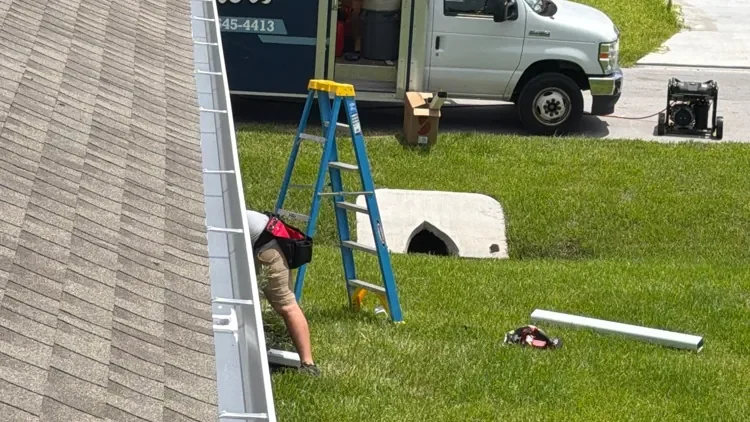
“Licensed and insured” is printed on more truck doors and yard signs in Southwest Florida than almost any other phrase. For a lot of gutter companies here, it isn’t true in the way a homeowner thinks it is.
The company may have a city or county business tax receipt. It may carry an insurance policy. But if it doesn’t hold a Florida contractor’s license, that policy was almost certainly written for some other kind of work, like cleaning or handyman services, and not for hanging aluminum off the edge of your roof. That gap is why some quotes come in so cheap, and it’s why we tell every homeowner the same thing: the most expensive job is the one you do twice.
In this guide: What “licensed” really means · Which licenses can install gutters · Insured for what? · The handyman and cleaning-company workaround · Why Florida has so many · What a cheap quote leaves out · How to check in 5 minutes
QUICK ANSWER
Is “licensed and insured” enough?
Not on its own. Installing gutters in Florida takes a state contractor’s license: at minimum a Specialty Structure license, or a residential, building, general or roofing contractor license. Ask for the number and look it up at myfloridalicense.com. A business tax receipt is a tax registration, not a contractor’s license. Many unlicensed gutter outfits register as cleaning or handyman businesses, and their insurance is written for that work, so it may not cover an installation that goes wrong on your home. A cheap quote from a company like that is the most expensive job you’ll buy, because you end up paying to do it twice.
What “licensed” really means in Florida
In Florida, a contractor’s license is issued by the Department of Business and Professional Regulation (DBPR) after the person qualifying the company passes state exams, shows experience and proves financial responsibility. Ours is a Certified Building Contractor license, CBC1270165, and anyone can look it up in about thirty seconds.
That is very different from the paperwork most small businesses carry:
| What they show you | What it actually is | Does it let them install gutters? |
|---|---|---|
| Business tax receipt (BTR) | A city or county tax registration. Anyone who pays the fee gets one. | No. It’s a tax receipt, not a competency license. |
| Sunbiz LLC filing | Proof the company exists as a legal entity. | No. |
| “Handyman” label | Florida does not issue a handyman license at all. | No. Gutter installation is licensed contractor work, so the handyman exemption doesn’t cover it. |
| An old county certificate | Florida phased out local contractor licenses. Lee County ended its program in 2023, and remaining local licenses expired July 1, 2025. | No. Gutter work now requires a state license. |
| State contractor’s license (DBPR) | Exams, experience, financial checks, continuing education. | Yes, anywhere in Florida, within the license’s scope. |
Since July 1, 2025, Florida licenses contractors at the state level. Counties can still require permits and business tax receipts, but they no longer issue their own contractor licenses for this work. So the question is simple: does the company have a state license number, and does it check out?
Which licenses can install gutters in Florida
Installing a gutter system means fastening a structure to your home, and in Florida that’s licensed contractor work. At a minimum, the company installing your gutters should hold one of these:
| License | License number starts with | What it covers |
|---|---|---|
| Specialty Structure Contractor (state) | SCC | Aluminum and screen work. Florida’s rule for this license names gutters, soffit and fascia in its scope. This is the minimum state license built for gutter work. |
| Residential Contractor (state) | CRC | Construction and repair of homes up to two stories, including gutters. |
| Building Contractor (state) | CBC | Commercial buildings and homes up to three stories, including gutters. This is our license: CBC1270165. |
| General Contractor (state) | CGC | Any work requiring a contractor license, including gutters. |
| Roofing Contractor (state) | CCC | Roofing work, and roofers commonly install gutters along with the roof. |
If the company in your driveway can’t show you one of these, it isn’t licensed to install your gutters, no matter what the truck door says.
“Insured” for what?
This is the part almost nobody checks. Business insurance isn’t one-size-fits-all. A general liability policy and a workers’ compensation policy are written and priced for the specific kind of work the business says it does. A gutter cleaning business, a pressure-washing business and a handyman business all pay lower premiums than a contractor that installs systems on roofs, because the risk is lower.
So when an unlicensed company files as a cleaning or handyman business, it usually buys insurance for cleaning or handyman work. Then it shows up at your house to install a full gutter system. If a gutter run pulls off your fascia in a storm, water ends up in your walls, or a worker falls off a ladder, the claim lands on a policy that was never written for that job. Insurers can and do push back on claims for work outside what a policy covers. That’s the difference between being insured and being insured for the work in front of you.
Workers’ comp is the one that hits homeowners
Florida requires construction employers with even one employee to carry workers’ compensation. If a crew member gets hurt on your property and the company has no comp policy, or only has a comp exemption for the owner while paying “helpers” under the table, the injured worker’s lawyer may start looking at whose property they were on. Ask for a certificate of insurance that shows both general liability and workers’ comp, and check that the policy is current on the day the job starts.
The handyman and cleaning-company workaround
Here’s how it usually works. Florida has no handyman license. State law exempts work that is “casual, minor, or inconsequential” when the whole job, labor and materials, stays under $2,500, but that exemption doesn’t reach work that falls within a licensed trade, it doesn’t allow splitting a job into smaller invoices, and it doesn’t let a handyman advertise as a contractor.
A full gutter installation is licensed work, whatever it costs. It’s named in the scope of the Specialty Structure license, and it’s covered by residential, building and general contractor licenses. So a handyman or cleaning company quoting you a full gutter system isn’t exempt. It’s unlicensed. Watch for:
- A quote split into two or three invoices for “front” and “back” of the house.
- Business names built around cleaning, pressure washing, property maintenance or “home services.”
- A license number that turns out to be a business tax receipt number.
- No license number anywhere on the truck, the website or the quote. Florida requires licensed contractors to include their license number in their advertising.
- A request for a large cash deposit before any materials are ordered.
There’s also a reason this matters to you if something goes wrong: under Florida law, a contract signed by an unlicensed contractor can’t be enforced by that contractor. That protects homeowners from paying for illegal work, but it also tells you how the state views these jobs. Unlicensed contracting is a crime in Florida, and it becomes a felony when it happens during a declared state of emergency, which is exactly when Southwest Florida sees the most of it.
Why there are so many of them in Florida
In July 2026 we checked every gutter company we could find advertising in Lee and Collier counties against the state’s licensee database. Of 91 companies, 12 held a valid Florida contractor’s license. We’re one of them. With local licenses gone, the state license is the only one that counts, so that gap is real. A few reasons it’s so wide here:
- The barrier to entry is a ladder and a truck. A used gutter machine and a business tax receipt are enough to start quoting.
- Storms create sudden demand. After every major hurricane, out-of-area crews and brand-new outfits flood in. Some stay.
- Gutters look simple. Homeowners who would never hire an unlicensed electrician don’t think twice about gutters, until the water ends up in the wrong place.
- Nobody checks. Most homeowners take “licensed and insured” at face value, so there’s little cost to printing it.
What a cheap quote usually leaves out
When one quote comes in far below the others, it’s almost never because that company found a smarter way to do the same job. It’s because the cost of doing it right was left out somewhere. The usual places:
| Left out | What it saves them | What it costs you later |
|---|---|---|
| A contractor’s license | Exams, bonding, continuing education | No state recourse and no licensing board to complain to |
| Insurance written for installation work | Thousands a year in premiums | A denied claim when something goes wrong |
| Workers’ comp | One of the biggest costs in the trade | Liability exposure if a worker is hurt on your property |
| Gutter size and gauge | Cheaper, thinner metal, often 5″ | Overflow in summer storms, dents, sagging |
| Enough hangers and downspouts | Material and labor | Sagging runs, leaking corners, water at the foundation |
| A real warranty | Nothing to honor later | Paying someone else to fix it |
That’s why we say the most expensive job is the one you do twice. A gutter system that has to be torn off and replaced in two years doesn’t cost the cheap quote. It costs the cheap quote plus the real one, plus whatever the water damaged in between. We see these jobs every month: undersized gutters that overflow every afternoon in July, runs hanging off rotted fascia, downspouts dumping right against the slab.

How to check a gutter contractor in 5 minutes
- Ask for the license number. A real contractor gives it to you without hesitation. Ours is CBC1270165.
- Look it up at myfloridalicense.com. Use “Verify a License,” search by name or number, and check that the status reads current and active and the name matches the company quoting you.
- If they say it’s a county license, that’s a red flag. Local contractor licenses expired statewide on July 1, 2025.
- Ask for a certificate of insurance showing general liability and workers’ comp, sent from the insurance agent, not a photo of an old card.
- Read the quote. It should list gutter size, aluminum gauge, downspout size and count, and the warranty, in writing.
- Ask who’s doing the work. The company’s own employees, or subcontractors?
If any of those answers come back fuzzy, keep shopping. A good contractor expects these questions.
Questions we get
Do you need a license to install gutters in Florida?
Yes. A full gutter installation is licensed contractor work. At a minimum the installer should hold a Specialty Structure (SCC), residential (CRC), building (CBC), general (CGC) or roofing (CCC) license from the state. Local county licenses expired in 2025, and the handyman exemption does not cover gutter installs. Verify any license at myfloridalicense.com.
Is a business tax receipt a contractor’s license?
No. A business tax receipt is a city or county tax registration. Anyone who pays the fee can get one, and it says nothing about whether the company is qualified to install anything.
What does “licensed and insured” mean?
It should mean the company holds a contractor’s license for the work and carries general liability and workers’ comp written for that work. Ask for both the license number and a current certificate of insurance, and verify them yourself.
Why are some gutter quotes so much cheaper?
Usually because something was left out: the license, insurance written for installation work, workers’ comp, heavier aluminum, enough hangers and downspouts, or a real warranty. Compare quotes line by line, not just the total.
Get a quote from a licensed gutter contractor
We’re veteran-owned and state-licensed (CBC1270165). Our own uniformed crews do every job, with a written quote, a 5-year workmanship warranty and a 20-year material warranty on new gutters.
Written by Garrett Schempp, co-owner of The Brothers That Just Do Gutters of Fort Myers–Naples, a veteran-owned, state-licensed gutter company (CBC1270165) based in south Fort Myers.
Sources
- Florida DBPR: Verify a License
- Florida Statutes 489.128: Contracts entered into by unlicensed contractors unenforceable
- Fla. Admin. Code R. 61G4-15.015: Certification of Specialty Structure Contractors
- Town of Fort Myers Beach: Contractors and scope of licensure (license prefixes)
- Florida Statutes 489.105: Contractor definitions
- Legal Clarity: Is there a handyman license in Florida?
- Jimerson Birr: Workers’ compensation requirements for the construction industry
- Jimerson Birr: Contractor advertising must include your license number
- Lee County Ordinance 23-09: Repeal of local contractor licensing
- Contractor Licensing Inc.: Florida local contractor licenses and the July 1, 2025 deadline