

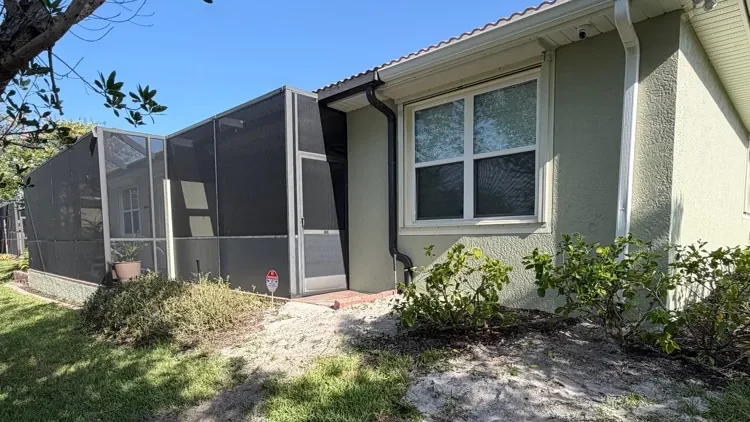
Homeowners use “French drain” for just about any pipe in the ground. But a French drain and an underground downspout drain are two different systems that solve two different problems, and mixing them up is one of the most common drainage mistakes we see in Southwest Florida.
QUICK ANSWER
What’s the difference between a French drain and an underground downspout drain?
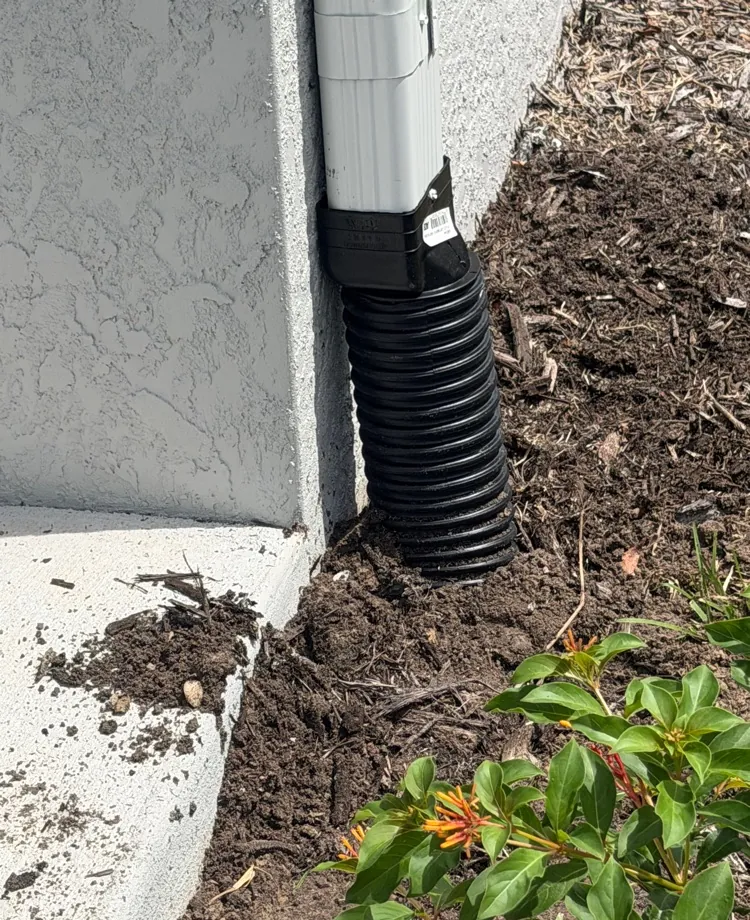
An underground downspout drain uses solid pipe to carry roof water from your downspouts away from the house to a safe discharge point, like a drain box or pop-up emitter. A French drain uses perforated pipe in a gravel trench to collect water that’s already in the soil or sitting on the surface. Downspouts should go into solid pipe. Sending a downspout into a French drain next to your house puts roof water back into the ground right where you don’t want it.
| Underground downspout drain | French drain | |
|---|---|---|
| Pipe | Solid wall | Perforated |
| Job | Move roof water away from the house | Collect groundwater or surface water along its length |
| Water source | Downspouts and catch basins | Saturated soil, yard runoff |
| Ends at | Drain box, catch basin or pop-up emitter | A daylight outlet or another drain |
| Best for | Water pooling at the foundation, washed-out beds, wet pool decks | Soggy yards, slopes, wet basements in other parts of the country |
Why Southwest Florida homes need downspout drains
Most lots here are flat and sandy. When a downspout dumps right at the corner of the house, the water has nowhere to go. It pools against the slab, washes out the fill under it and over time can lead to uneven settling and cracked stucco. A splash block just moves the problem a couple of feet. In rainy season, when Fort Myers gets around 9 to 10 inches of rain a month, that adds up fast.
An underground downspout drain fixes it by carrying the water to a place where it can drain safely, away from the foundation, the pool deck, the driveway and the landscaping.
Why French drains are a different tool
A French drain is built to let water in along its whole length. That’s great for a soggy side yard. It’s the opposite of what you want right next to your foundation, where the goal is to get water away. In much of Lee and Collier counties the ground is already near saturation during the wet season, so a perforated pipe next to the house can end up holding water instead of moving it.
How we install underground downspout drainage
- Downspouts tie into 4″ or 6″ solid corrugated pipe with sealed transitions, so debris can’t get into the line.
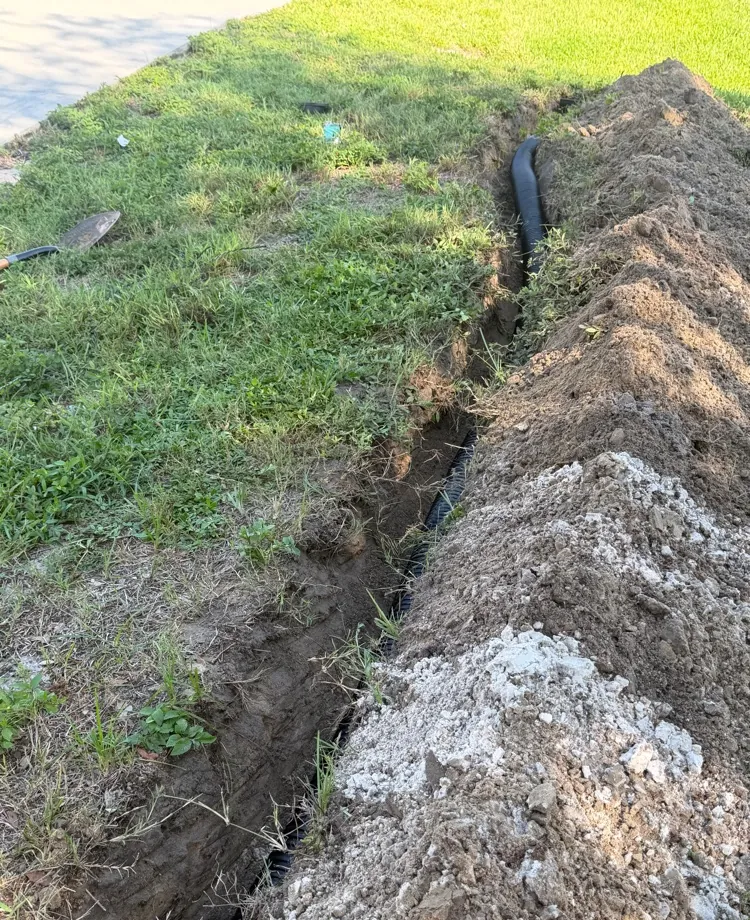
- Pipe is buried with a steady slope away from the home.
- Each line ends at a drain box, catch basin or pop-up emitter where the water can drain away.
- We call Sunshine 811 before we dig so utility lines get marked.
- Every line is flow-tested before we leave, and every system is backed by a 2-year limited warranty.
What about a low spot in the yard?
If water sits in one low spot after every storm, a catch basin set where the water collects and piped underground to somewhere it can drain often fixes it, with or without a gutter attached. If your yard needs something bigger than that, we’ll tell you whether drainage is the right fix.
Signs your downspouts need to go underground
- Water pooling along the foundation after a storm.
- Washed-out mulch, sod or soil under a downspout.
- Water running across a walkway, driveway or pool deck.
- Stains or cracks in the stucco near the ground.
- Extensions you trip over, mow around or keep putting back.
Already have underground drains?
We can clean out most existing systems that still work. If a system is too old or has collapsed, we’ll tell you, and show you why replacing it makes more sense.
Questions we get
Can I connect my downspouts to a French drain?
We don’t recommend it next to the house. Downspouts should go into solid pipe that carries the water away.
How deep is underground downspout drainage?
Deep enough to protect the pipe, with a steady slope to the discharge point. Every yard is different, so we lay it out on site.
Do underground drains clog?
Sealed tie-ins and clean gutters keep most debris out. Gutter guards and regular cleanings help even more.
Water pooling around your house?
We’ll walk the property, find where the water is going and give you a written plan to carry it away.
Written by Garrett Schempp, co-owner of The Brothers That Just Do Gutters of Fort Myers–Naples, a veteran-owned, state-licensed gutter company (CBC1270165) based in south Fort Myers.