Homeowners use “French drain” for just about any pipe in the ground. But a French drain and an underground downspout drain are two different systems that solve two different problems, and mixing them up is one of the most common drainage mistakes we see in Southwest Florida.
QUICK ANSWER
What’s the difference between a French drain and an underground downspout drain?
An underground downspout drain uses solid pipe to carry roof water from your downspouts away from the house to a safe discharge point, like a drain box or pop-up emitter. A French drain uses perforated pipe in a gravel trench to collect water that’s already in the soil or sitting on the surface. Downspouts should go into solid pipe. Sending a downspout into a French drain next to your house puts roof water back into the ground right where you don’t want it.
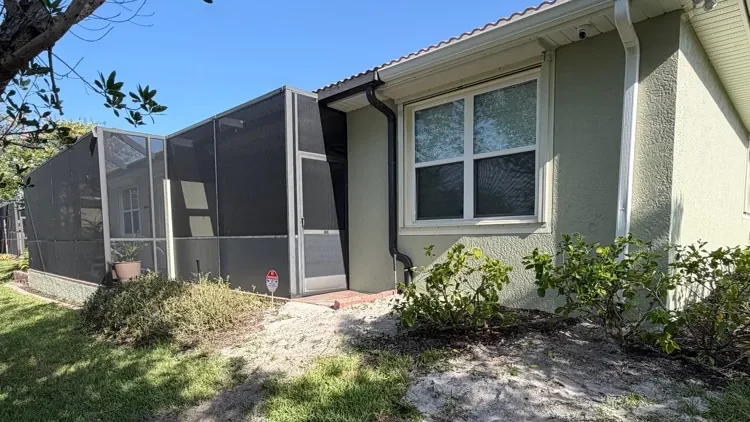
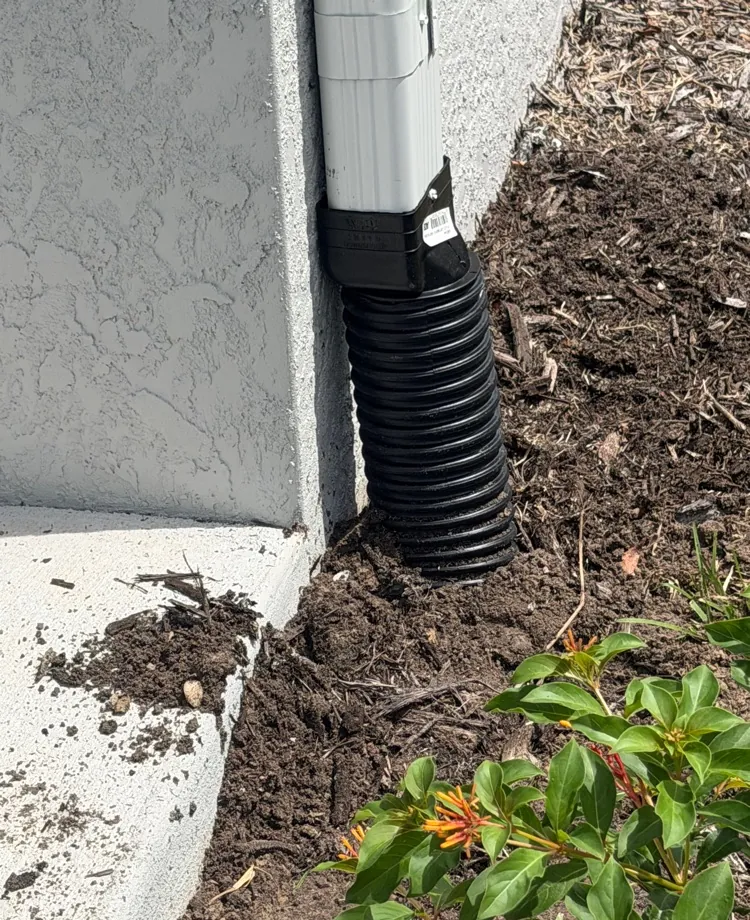
A downspout tied into a sealed underground drain line in Lehigh Acres.
Underground downspout drain
French drain
Pipe
Solid wall
Perforated
Job
Move roof water away from the house
Collect groundwater or surface water along its length
Water source
Downspouts and catch basins
Saturated soil, yard runoff
Ends at
Drain box, catch basin or pop-up emitter
A daylight outlet or another drain
Best for
Water pooling at the foundation, washed-out beds, wet pool decks
Soggy yards, slopes, wet basements in other parts of the country
Why Southwest Florida homes need downspout drains
Most lots here are flat and sandy. When a downspout dumps right at the corner of the house, the water has nowhere to go. It pools against the slab, washes out the fill under it and over time can lead to uneven settling and cracked stucco. A splash block just moves the problem a couple of feet. In rainy season, when Fort Myers gets around 9 to 10 inches of rain a month, that adds up fast.
An underground downspout drain fixes it by carrying the water to a place where it can drain safely, away from the foundation, the pool deck, the driveway and the landscaping.
Why French drains are a different tool
A French drain is built to let water in along its whole length. That’s great for a soggy side yard. It’s the opposite of what you want right next to your foundation, where the goal is to get water away. In much of Lee and Collier counties the ground is already near saturation during the wet season, so a perforated pipe next to the house can end up holding water instead of moving it.
How we install underground downspout drainage
Downspouts tie into 4″ or 6″ solid corrugated pipe with sealed transitions, so debris can’t get into the line.
Pipe is buried with a steady slope away from the home.
Each line ends at a drain box, catch basin or pop-up emitter where the water can drain away.
We call Sunshine 811 before we dig so utility lines get marked.
Every line is flow-tested before we leave, and every system is backed by a 2-year limited warranty.
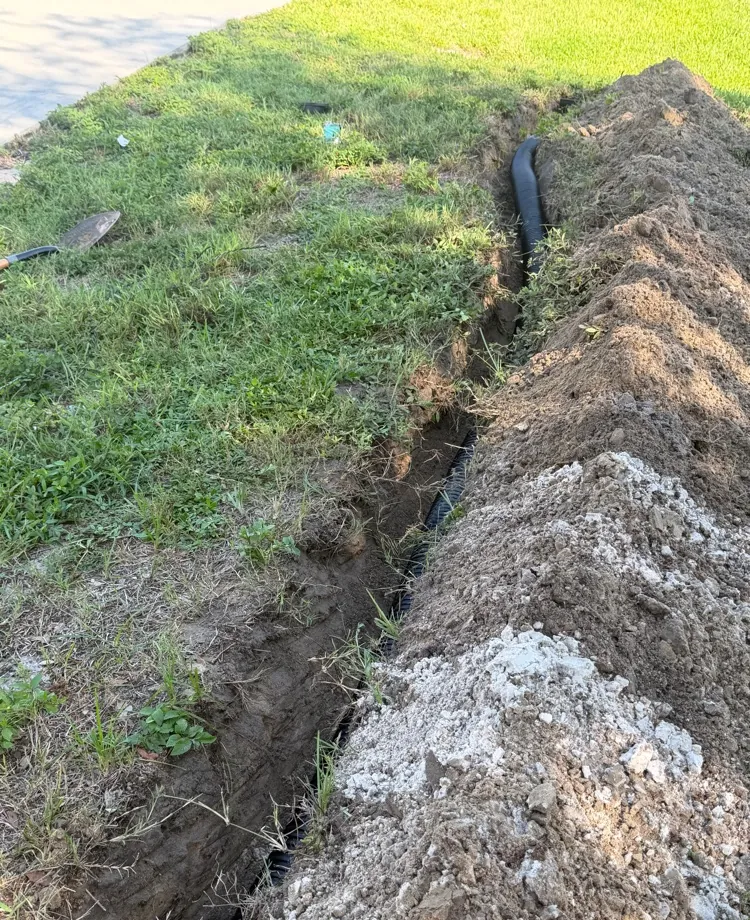
Solid drain pipe laid with a steady slope before backfill in Fort Myers.
What about a low spot in the yard?
If water sits in one low spot after every storm, a catch basin set where the water collects and piped underground to somewhere it can drain often fixes it, with or without a gutter attached. If your yard needs something bigger than that, we’ll tell you whether drainage is the right fix.
Signs your downspouts need to go underground
Water pooling along the foundation after a storm.
Washed-out mulch, sod or soil under a downspout.
Water running across a walkway, driveway or pool deck.
Stains or cracks in the stucco near the ground.
Extensions you trip over, mow around or keep putting back.
Already have underground drains?
We can clean out most existing systems that still work. If a system is too old or has collapsed, we’ll tell you, and show you why replacing it makes more sense.
Questions we get
Can I connect my downspouts to a French drain?
We don’t recommend it next to the house. Downspouts should go into solid pipe that carries the water away.
How deep is underground downspout drainage?
Deep enough to protect the pipe, with a steady slope to the discharge point. Every yard is different, so we lay it out on site.
Do underground drains clog?
Sealed tie-ins and clean gutters keep most debris out. Gutter guards and regular cleanings help even more.
Water pooling around your house?
We’ll walk the property, find where the water is going and give you a written plan to carry it away.
Written by Garrett Schempp, co-owner of The Brothers That Just Do Gutters of Fort Myers–Naples, a veteran-owned, state-licensed gutter company (CBC1270165) based in south Fort Myers.
After a hurricane or tropical storm, gutters are one of the first things homeowners notice: a section hanging off the corner, a downspout in the neighbor’s yard, a run that suddenly sags. Some of that is a quick repair. Some of it means the system is done. Here’s how to tell the difference, what to do first, and the insurance deadlines Florida homeowners need to know.
QUICK ANSWER
Should you repair or replace storm-damaged gutters?
Repair is usually fine for a single loose section, a disconnected downspout or a leaking corner on a system that was in good shape before the storm. Replacement makes more sense when several sections are bent or torn off, the fascia behind them is damaged, or the gutters were already undersized or near the end of their life. Photograph everything before anything is fixed, and in Florida, report the damage to your insurer within one year of the hurricane’s landfall.
A storm repair in Fort Myers: hidden hangers added to re-secure a run that pulled loose.
First: stay safe and document
Stay off ladders and roofs while things are wet and winds are gusting.
Keep clear of gutters near downed power lines or service drops.
Photograph and video every side of the house, close up and from a distance, before anything is moved or repaired.
Pick up downspouts and pieces that came off and keep them. They’re part of the record.
If water is getting into the house, take reasonable steps to stop more damage, and keep receipts.
Repair or replace: how we decide
What you see
Usually
Why
One downspout knocked loose
Repair
Re-attach, re-strap, replace a crushed elbow
A corner leaking after the storm
Repair
Clean and reseal, then check why it opened
One section pulled off the fascia, fascia solid
Repair
Re-hang with new hidden hangers
Several sections bent, kinked or torn off
Replace
Bent aluminum doesn’t hold its pitch
Gutter pulled off with rotted fascia
Replace fascia, then re-hang or replace
Nothing holds on a rotted board
Water poured over the edge during the storm
Often replace
Usually undersized or too few downspouts
Old system that was already leaking at every seam
Replace
The storm just finished the job
We fix what can be fixed and tell you straight when a run is better replaced. We don’t re-pitch sagging gutters and call it a day, because sagging after a storm usually means the hangers, the fascia or the gutter itself has failed. Patching it means paying for it twice.
Rotted fascia behind an old gutter. A storm finds weak boards fast.
Florida insurance deadlines to know
Florida law sets firm notice deadlines for property claims:
New or reopened claims: notice must be given within 1 year after the date of loss.
Supplemental claims (more damage found from the same event): within 18 months.
For hurricanes, the date of loss is the date the hurricane made landfall.
Gutter damage alone is often close to a deductible, so talk to your agent about whether a claim makes sense. Either way, your photos and a written assessment from a licensed contractor will help. We’re not adjusters and we don’t handle claims, but we’ll give you a clear written description and photos of what we find.
Watch out for storm chasers
After every major storm, door-knockers and new “gutter companies” show up across Lee and Collier counties. Unlicensed contracting during a declared state of emergency is a felony in Florida, and it’s still common. Before you sign anything:
Don’t hand over a large cash deposit to someone you just met.
Get the scope, gutter size, gauge and warranty in writing.
Be wary of anyone pushing you to sign today.
Get ahead of the next one
Gutters fail in storms mostly for the same reasons: clogs, undersized gutters, too few downspouts, hangers spaced too far apart and rotted fascia. A spring cleaning and inspection catches most of it. Our Rain Ready Club members get two visits a year, and priority scheduling after a storm, when everyone else is waiting.
Questions we get
How soon can you come out after a storm?
As soon as conditions are safe. Rain Ready Club members go to the front of the line.
Does homeowners insurance cover gutter damage?
It depends on your policy, deductible and the cause of the damage. Talk to your agent and document everything first.
Can I just re-hang the gutters myself?
If a single section came off a solid fascia board, maybe. If the aluminum is bent or the fascia is soft, re-hanging it won’t hold through the next storm.
Storm damage? Get a straight answer.
We’ll look at the whole system, photograph what we find and tell you honestly whether it’s a repair or a replacement.
Written by Garrett Schempp, co-owner of The Brothers That Just Do Gutters of Fort Myers–Naples, a veteran-owned, state-licensed gutter company (CBC1270165) based in south Fort Myers.
If you have a concrete or clay tile roof in Southwest Florida, you’ve probably watched water shoot right over the front of a gutter during a summer storm. That’s usually not a clog. It’s a gutter that’s too small for the roof above it. Here’s how we decide between 6″ and 7″ gutters, and why most tile homes we work on get 7″.
QUICK ANSWER
Do tile roofs need 7-inch gutters?
Most do. Tile sheds water fast, tile homes here tend to have large roofs and deep overhangs, and valleys concentrate water into a few spots. A 7″ gutter holds and moves much more water than a 6″. We size every home by its roof, not its roof type alone, but the majority of tile homes we install on get 7″ gutters in .032 aluminum. We don’t install 5″ K-style gutters on Southwest Florida homes at all. They can’t keep up with our storms.
7″ black seamless gutters with ONE Gutter Guard on a tile-roof home in Wildcat Run, Estero.
6-inch vs 7-inch at a glance
6″ seamless
7″ seamless
Aluminum
.027 standard; .032 available in white
Always .032
Downspouts
3×4
3×4 on most homes; 4×5 for heavy water or tight spots; always 4×5 on commercial
Best for
Most shingle and many metal-roof homes
Tile roofs, large or steep roofs, long runs, valleys, commercial
Cost
Lower
Somewhat higher: bigger gutter, heavier metal
Why tile roofs push more water
Tile sheds water fast. Water runs off concrete and clay tile quickly and hits the gutter hard instead of trickling in.
Bigger roofs. Many tile homes in Naples, Estero, Bonita Springs and Cape Coral have large, complex rooflines, so each run of gutter collects water from a lot of roof.
Deep overhangs. Water leaving a tile edge can carry past the back of a small gutter.
Valleys. Where two roof planes meet, the valley funnels a huge amount of water into one spot on the gutter.
Summer storms. Southwest Florida’s afternoon storms dump heavy rain in short bursts. That’s the moment a gutter has to handle.
How we decide
We don’t pick a gutter size off a chart. On every estimate we look at:
How much roof drains into each run.
The pitch and the roof material.
Valleys and upper roofs that dump onto lower ones.
Where downspouts can actually go on the house.
Whether there’s a pool cage, entry or walkway where overflow would land.
Size is mostly a question of roof size and water volume. Some large or steep metal roofs get 7″ too. Some smaller tile roofs do fine with a well-placed 6″ system. We’ll tell you which one your house needs and why, in writing.
Don’t forget the downspouts
A bigger gutter only helps if the water can get out. On most 7″ homes we use 3×4 downspouts because they look cleaner on the house. Where the water load is heavy, or where a downspout can’t go where it ideally should, we step up to 4×5. If downspouts are dumping right next to the foundation, underground drainage carries the water away.
Guards on tile roofs
Yes, we install gutter guards on tile roofs. The guard has to be fitted to the tile profile without lifting or cracking tiles, which is part of why we look at every roof in person. Adding ONE Gutter Guard to new Brothers gutters adds 5 years to the 5-year workmanship warranty, for 10 years total.
Seamless gutters on a two-story tile home in Cape Coral.
Questions we get
Can I put 6-inch gutters on a tile roof?
Sometimes, on a smaller tile roof with good downspout placement. On most tile homes we recommend 7″.
Are 7-inch gutters too big for a house?
Not on the right house. On a large tile home they look proportional, and with 3×4 downspouts the system stays clean-looking.
What about 5-inch gutters?
We don’t install 5″ K-style gutters on Southwest Florida homes because they can’t keep up with our storms. The only 5″ we install is a roll-formed box gutter on carports and manufactured homes.
Written by Garrett Schempp, co-owner of The Brothers That Just Do Gutters of Fort Myers–Naples, a veteran-owned, state-licensed gutter company (CBC1270165) based in south Fort Myers.
In Southwest Florida, when you clean your gutters matters as much as how often. About two-thirds of Fort Myers’ yearly rain falls in just four months, June through September. A gutter that’s packed with spring oak leaves when those daily storms start doesn’t just overflow. It sends that water down your walls and into the ground right against your foundation.
When should you clean gutters in Southwest Florida?
At least twice a year: once in spring (March to May), after the oaks drop their leaves and tassels and before rainy season starts, and once in late fall (November to December), after rainy season and hurricane season wind down. Homes under heavy oak, pine or palm cover may need more, and every home should get a check after a named storm.
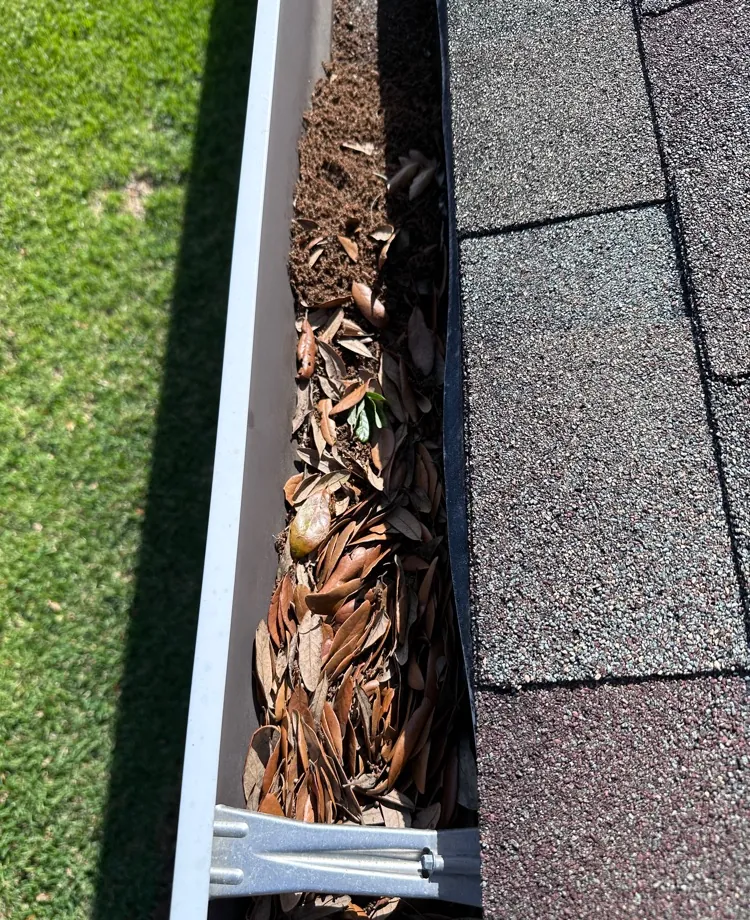
Oak leaves packed into a Fort Myers gutter, right before rainy season.
When the rain comes in Fort Myers
Here are the 1991–2020 climate normals for Fort Myers from the National Weather Service. The summer jump is the whole story:
Month
Normal rain (inches)
January
2.43
February
1.78
March
2.07
April
2.44
May
3.46
June
9.66
July
9.38
August
10.43
September
9.00
October
3.08
November
1.78
December
1.90
Year
57.41
Fort Myers monthly normal precipitation, 1991–2020. Source: National Weather Service Tampa Bay.
June through September adds up to about 38.5 inches, roughly 67% of the year’s rain. And it doesn’t fall gently. Summer storms here often dump heavy rain in a short burst, which is exactly when a half-clogged gutter overflows. Hurricane season runs June 1 through November 30 on top of that.
What clogs Southwest Florida gutters, and when
What falls
When
What it does in a gutter
Live oak leaves
Late winter into spring
Small, waxy leaves pack flat and hold water
Oak tassels (catkins)
Spring
Stringy clumps that mat over downspout openings
Palm fronds, flowers and seed pods
Year-round
Heavy debris that blocks corners and outlets
Pine needles
Year-round
Weave through guards and build a mat
Storm debris
June to November
Leaves, twigs and shingle grit all at once
Spring is the big one. The oaks drop right before the rain starts, so a spring cleaning clears the worst debris of the year at exactly the right time.
A cleaning schedule that fits Southwest Florida
Spring (March to May): the most important cleaning of the year. Clear the oak leaves and tassels before rainy season.
Late fall (November to December): clear what built up over the summer and check for anything storms loosened.
After any named storm: look for debris, bent sections, loose downspouts and corners pulling apart.
Heavy tree cover: homes right under oaks or pines may need three or four cleanings a year, or gutter guards.
That two-visit rhythm is exactly how our Rain Ready Club works: a spring visit before rainy season and a late-fall visit after it, each with a full cleaning, a 5-point inspection, up to 3 seam reseals and photos when we’re done. Members also get priority scheduling after a storm. If you have a super gutter over your pool cage, we clean that too, which keeps the pool deck from getting soaked.
Signs your gutters need cleaning now
Water pouring over the front edge during a storm.
Plants or grass growing in the gutter.
Downspouts that barely trickle in a heavy rain.
Staining on the fascia or stucco below the gutter.
Washed-out mulch or soil along the house.
A gutter that’s starting to sag or pull away. Wet debris is heavy.
Do gutter guards mean no more cleaning?
Good gutter guards cut cleaning way down, but no guard makes a gutter maintenance-free. Fine debris and oak tassels can still sit on top of a guard. The right guard depends on what’s falling on your roof, which is why we offer three levels.
Should you do it yourself?
On a one-story home with a safe, level place for the ladder, plenty of homeowners clean their own gutters. On two-story homes, tile roofs and anything over a pool cage, we’d rather you didn’t. Tile breaks under foot traffic and ladder falls are no joke.
Questions we get
How often should gutters be cleaned in Florida?
At least twice a year in Southwest Florida: spring and late fall. Homes under heavy tree cover may need more.
What’s the best month to clean gutters in Fort Myers?
April or May is ideal: after spring oak drop, before the June rains.
How much does gutter cleaning cost?
It depends on the size of the home, how many feet of gutter it has and how much debris is packed in. We give you the price before we start.
Get your gutters rain ready
Gutter cleaning across Lee and Collier counties, with photos when we’re done. Or join the Rain Ready Club and never think about it again.
Written by Garrett Schempp, co-owner of The Brothers That Just Do Gutters of Fort Myers–Naples, a veteran-owned, state-licensed gutter company (CBC1270165) based in south Fort Myers.
“How much do new gutters cost?” is the first question almost every homeowner asks us, and the honest answer is that it depends on your house. But it doesn’t have to be a mystery. Here’s what full seamless gutter installs actually run in Southwest Florida, what moves the price up or down, and how to compare quotes without getting burned.
How much do new gutters cost in Fort Myers, Cape Coral and Naples?
Most full seamless gutter installations we do run about $2,000 to $4,000. In Naples, Bonita Springs and Estero, where homes tend to be larger and tile roofs call for 7″ gutters, most jobs land between $2,500 and $5,000. In Lehigh Acres, where homes are often smaller and single-story, $1,500 to $3,000 is typical. Your written quote depends on how many feet of gutter the home needs, 6″ or 7″, the number of stories and downspouts, and any guards, drainage or fascia work.
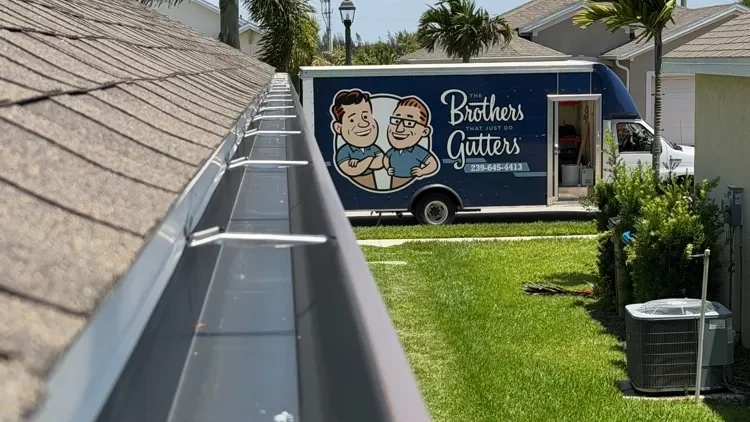
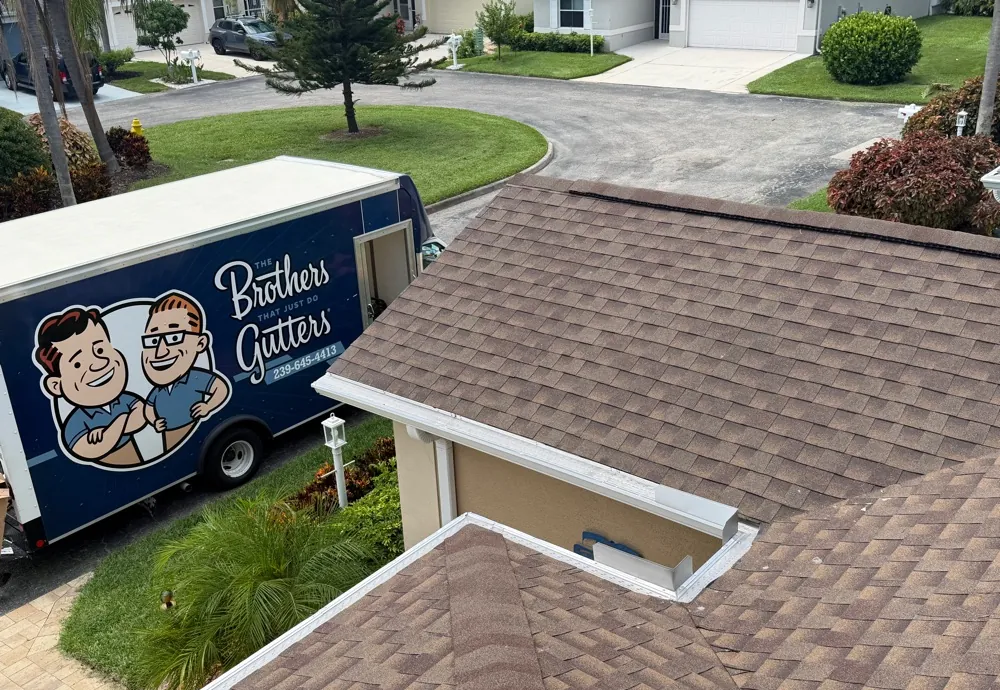
Our gutter truck on a Fort Myers job. Seamless gutters are formed on site to fit the house.
Typical price ranges by area
Area
Typical full install
Why
Fort Myers and Cape Coral
$2,000 to $4,000
A wide mix of one- and two-story homes, shingle, tile and metal roofs
Naples, Bonita Springs and Estero
$2,500 to $5,000
Larger homes and more tile roofs, which usually need 7″ gutters
Lehigh Acres
$1,500 to $3,000
More single-story homes with shorter gutter runs
Ranges for full seamless gutter installs we’ve done in each area. Your home gets its own written quote.
Those are ranges, not quotes. A small single-story home with a simple roofline can come in under them, and a large two-story tile home with lots of corners, guards and underground drainage can land above them.
What drives the price
1. How many feet of gutter the home needs
Gutters are priced mostly by the run. A home with a long, simple roofline needs fewer corners and less labor than one with lots of bump-outs, gables and inside corners.
2. 6-inch or 7-inch
We only install 6″ and 7″ seamless gutters on Southwest Florida homes. Our 6″ gutters are .027 aluminum, with .032 available in white for homeowners who want a heavier gauge. Our 7″ gutters are always .032 aluminum. A 7″ system costs somewhat more because the gutter is bigger and the metal is heavier, but on tile roofs and large roofs it’s usually the right call. Here’s how to tell which one your home needs.
3. Stories and access
Two-story homes, steep pitches, pool cages and tight side yards all take more time and more ladder work.
4. Downspouts
More downspouts mean more material and labor, but they’re also what keep a gutter from overflowing. On 6″ gutters we use 3×4 downspouts. On 7″ homes we usually use 3×4 for looks and 4×5 where the water load is heavy or the downspout location is tight.
5. Material and color
Aluminum in a wide range of colors is standard: white, black, bronze, cream, ivory, almond, gray, musket brown, royal brown, eggshell and more. Copper, Galvalume and half-round gutters are special orders and are priced separately.
6. Taking off the old system and fixing what’s behind it
If the fascia behind your old gutters is rotted, it has to be replaced before new gutters can hang on it. We’ll show you what we find before any extra work is done.
Common add-ons
Gutter guards, in three levels from mesh to aluminum chassis with stainless steel mesh, chosen by budget and what’s falling on your roof. Adding ONE Gutter Guard to new Brothers gutters extends the system warranty to 10 years.
If one quote is far below the rest, find out what’s missing. The most expensive job is the one you do twice.
Financing
If you’d rather spread the cost out, we offer financing through Hearth. Checking your options is a soft credit check, and those who qualify can choose 0% or low monthly payment plans.
Questions we get
How much do seamless gutters cost per foot?
Per-foot pricing depends on the gutter size, gauge, color, stories and how complex the roofline is, so we quote the whole home instead. Most full installs we do run $2,000 to $4,000.
Are 7-inch gutters more expensive?
Somewhat. The gutter is larger and is always .032 aluminum. On tile and large roofs, they’re usually worth it because a 6″ gutter can’t keep up.
How long does a gutter install take?
Most homes are done in one day.
Do you give free estimates?
Yes. Every estimate is free and in writing.
Get your written gutter quote
Free written estimates across Lee and Collier counties, from a veteran-owned, state-licensed gutter company with our own crews.
Written by Garrett Schempp, co-owner of The Brothers That Just Do Gutters of Fort Myers–Naples, a veteran-owned, state-licensed gutter company (CBC1270165) based in south Fort Myers.
“Licensed and insured” is printed on more truck doors and yard signs in Southwest Florida than almost any other phrase. For a lot of gutter companies here, it isn’t true in the way a homeowner thinks it is.
The company may have a city or county business tax receipt. It may carry an insurance policy. But if it doesn’t hold a Florida contractor’s license, that policy was almost certainly written for some other kind of work, like cleaning or handyman services, and not for hanging aluminum off the edge of your roof. That gap is why some quotes come in so cheap, and it’s why we tell every homeowner the same thing: the most expensive job is the one you do twice.
Not on its own. Installing gutters in Florida takes a state contractor’s license: at minimum a Specialty Structure license, or a residential, building, general or roofing contractor license. Ask for the number and look it up at myfloridalicense.com. A business tax receipt is a tax registration, not a contractor’s license. Many unlicensed gutter outfits register as cleaning or handyman businesses, and their insurance is written for that work, so it may not cover an installation that goes wrong on your home. A cheap quote from a company like that is the most expensive job you’ll buy, because you end up paying to do it twice.
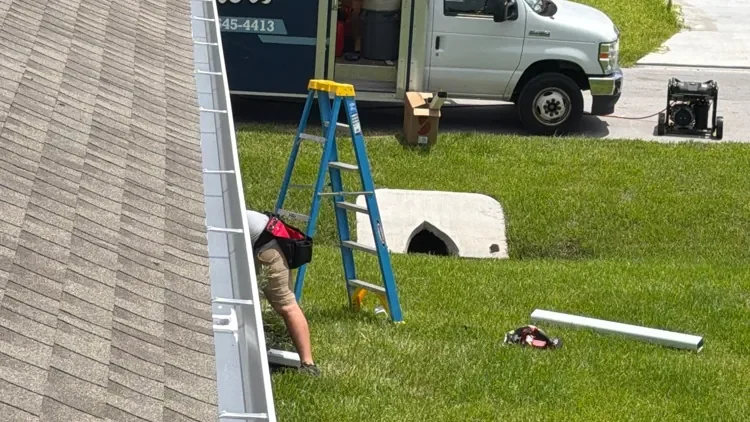
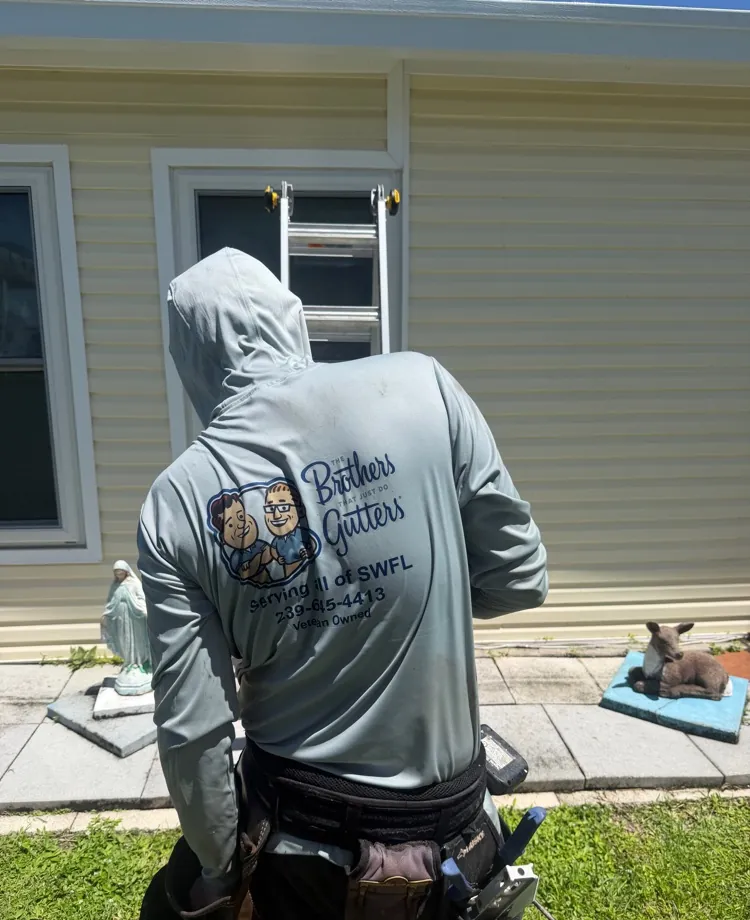
One of our own crew members on a North Fort Myers install. Every installer is our employee, covered by our workers’ comp.
What “licensed” really means in Florida
In Florida, a contractor’s license is issued by the Department of Business and Professional Regulation (DBPR) after the person qualifying the company passes state exams, shows experience and proves financial responsibility. Ours is a Certified Building Contractor license, CBC1270165, and anyone can look it up in about thirty seconds.
That is very different from the paperwork most small businesses carry:
What they show you
What it actually is
Does it let them install gutters?
Business tax receipt (BTR)
A city or county tax registration. Anyone who pays the fee gets one.
No. It’s a tax receipt, not a competency license.
Sunbiz LLC filing
Proof the company exists as a legal entity.
No.
“Handyman” label
Florida does not issue a handyman license at all.
No. Gutter installation is licensed contractor work, so the handyman exemption doesn’t cover it.
An old county certificate
Florida phased out local contractor licenses. Lee County ended its program in 2023, and remaining local licenses expired July 1, 2025.
Yes, anywhere in Florida, within the license’s scope.
Since July 1, 2025, Florida licenses contractors at the state level. Counties can still require permits and business tax receipts, but they no longer issue their own contractor licenses for this work. So the question is simple: does the company have a state license number, and does it check out?
Which licenses can install gutters in Florida
Installing a gutter system means fastening a structure to your home, and in Florida that’s licensed contractor work. At a minimum, the company installing your gutters should hold one of these:
License
License number starts with
What it covers
Specialty Structure Contractor (state)
SCC
Aluminum and screen work. Florida’s rule for this license names gutters, soffit and fascia in its scope. This is the minimum state license built for gutter work.
Residential Contractor (state)
CRC
Construction and repair of homes up to two stories, including gutters.
Building Contractor (state)
CBC
Commercial buildings and homes up to three stories, including gutters. This is our license: CBC1270165.
General Contractor (state)
CGC
Any work requiring a contractor license, including gutters.
Roofing Contractor (state)
CCC
Roofing work, and roofers commonly install gutters along with the roof.
Certified state licenses use these prefixes and are valid statewide. Registered state licenses start with R (like RB or RR) and are limited to the areas where the contractor qualified.
If the company in your driveway can’t show you one of these, it isn’t licensed to install your gutters, no matter what the truck door says.
“Insured” for what?
This is the part almost nobody checks. Business insurance isn’t one-size-fits-all. A general liability policy and a workers’ compensation policy are written and priced for the specific kind of work the business says it does. A gutter cleaning business, a pressure-washing business and a handyman business all pay lower premiums than a contractor that installs systems on roofs, because the risk is lower.
So when an unlicensed company files as a cleaning or handyman business, it usually buys insurance for cleaning or handyman work. Then it shows up at your house to install a full gutter system. If a gutter run pulls off your fascia in a storm, water ends up in your walls, or a worker falls off a ladder, the claim lands on a policy that was never written for that job. Insurers can and do push back on claims for work outside what a policy covers. That’s the difference between being insured and being insured for the work in front of you.
Workers’ comp is the one that hits homeowners
Florida requires construction employers with even one employee to carry workers’ compensation. If a crew member gets hurt on your property and the company has no comp policy, or only has a comp exemption for the owner while paying “helpers” under the table, the injured worker’s lawyer may start looking at whose property they were on. Ask for a certificate of insurance that shows both general liability and workers’ comp, and check that the policy is current on the day the job starts.
The handyman and cleaning-company workaround
Here’s how it usually works. Florida has no handyman license. State law exempts work that is “casual, minor, or inconsequential” when the whole job, labor and materials, stays under $2,500, but that exemption doesn’t reach work that falls within a licensed trade, it doesn’t allow splitting a job into smaller invoices, and it doesn’t let a handyman advertise as a contractor.
A full gutter installation is licensed work, whatever it costs. It’s named in the scope of the Specialty Structure license, and it’s covered by residential, building and general contractor licenses. So a handyman or cleaning company quoting you a full gutter system isn’t exempt. It’s unlicensed. Watch for:
A quote split into two or three invoices for “front” and “back” of the house.
Business names built around cleaning, pressure washing, property maintenance or “home services.”
A license number that turns out to be a business tax receipt number.
No license number anywhere on the truck, the website or the quote. Florida requires licensed contractors to include their license number in their advertising.
A request for a large cash deposit before any materials are ordered.
There’s also a reason this matters to you if something goes wrong: under Florida law, a contract signed by an unlicensed contractor can’t be enforced by that contractor. That protects homeowners from paying for illegal work, but it also tells you how the state views these jobs. Unlicensed contracting is a crime in Florida, and it becomes a felony when it happens during a declared state of emergency, which is exactly when Southwest Florida sees the most of it.
Why there are so many of them in Florida
In July 2026 we checked every gutter company we could find advertising in Lee and Collier counties against the state’s licensee database. Of 91 companies, 12 held a valid Florida contractor’s license. We’re one of them. With local licenses gone, the state license is the only one that counts, so that gap is real. A few reasons it’s so wide here:
The barrier to entry is a ladder and a truck. A used gutter machine and a business tax receipt are enough to start quoting.
Storms create sudden demand. After every major hurricane, out-of-area crews and brand-new outfits flood in. Some stay.
Gutters look simple. Homeowners who would never hire an unlicensed electrician don’t think twice about gutters, until the water ends up in the wrong place.
Nobody checks. Most homeowners take “licensed and insured” at face value, so there’s little cost to printing it.
What a cheap quote usually leaves out
When one quote comes in far below the others, it’s almost never because that company found a smarter way to do the same job. It’s because the cost of doing it right was left out somewhere. The usual places:
Left out
What it saves them
What it costs you later
A contractor’s license
Exams, bonding, continuing education
No state recourse and no licensing board to complain to
Insurance written for installation work
Thousands a year in premiums
A denied claim when something goes wrong
Workers’ comp
One of the biggest costs in the trade
Liability exposure if a worker is hurt on your property
Gutter size and gauge
Cheaper, thinner metal, often 5″
Overflow in summer storms, dents, sagging
Enough hangers and downspouts
Material and labor
Sagging runs, leaking corners, water at the foundation
A real warranty
Nothing to honor later
Paying someone else to fix it
That’s why we say the most expensive job is the one you do twice. A gutter system that has to be torn off and replaced in two years doesn’t cost the cheap quote. It costs the cheap quote plus the real one, plus whatever the water damaged in between. We see these jobs every month: undersized gutters that overflow every afternoon in July, runs hanging off rotted fascia, downspouts dumping right against the slab.
Undersized gutters pulling off rotted fascia. Fixing this costs far more than doing it right the first time.
How to check a gutter contractor in 5 minutes
Ask for the license number. A real contractor gives it to you without hesitation. Ours is CBC1270165.
Look it up at myfloridalicense.com. Use “Verify a License,” search by name or number, and check that the status reads current and active and the name matches the company quoting you.
If they say it’s a county license, that’s a red flag. Local contractor licenses expired statewide on July 1, 2025.
Ask for a certificate of insurance showing general liability and workers’ comp, sent from the insurance agent, not a photo of an old card.
Read the quote. It should list gutter size, aluminum gauge, downspout size and count, and the warranty, in writing.
Ask who’s doing the work. The company’s own employees, or subcontractors?
If any of those answers come back fuzzy, keep shopping. A good contractor expects these questions.
Questions we get
Do you need a license to install gutters in Florida?
Yes. A full gutter installation is licensed contractor work. At a minimum the installer should hold a Specialty Structure (SCC), residential (CRC), building (CBC), general (CGC) or roofing (CCC) license from the state. Local county licenses expired in 2025, and the handyman exemption does not cover gutter installs. Verify any license at myfloridalicense.com.
Is a business tax receipt a contractor’s license?
No. A business tax receipt is a city or county tax registration. Anyone who pays the fee can get one, and it says nothing about whether the company is qualified to install anything.
What does “licensed and insured” mean?
It should mean the company holds a contractor’s license for the work and carries general liability and workers’ comp written for that work. Ask for both the license number and a current certificate of insurance, and verify them yourself.
Why are some gutter quotes so much cheaper?
Usually because something was left out: the license, insurance written for installation work, workers’ comp, heavier aluminum, enough hangers and downspouts, or a real warranty. Compare quotes line by line, not just the total.
Get a quote from a licensed gutter contractor
We’re veteran-owned and state-licensed (CBC1270165). Our own uniformed crews do every job, with a written quote, a 5-year workmanship warranty and a 20-year material warranty on new gutters.
Written by Garrett Schempp, co-owner of The Brothers That Just Do Gutters of Fort Myers–Naples, a veteran-owned, state-licensed gutter company (CBC1270165) based in south Fort Myers.